
As businesses become more connected, the number of potential cybersecurity threats continues to grow. Organizations today operate through cloud applications, APIs, mobile apps, remote devices, customer databases, payment systems, and increasingly complex digital infrastructure.
At the same time, cyber threats are becoming more sophisticated.
Traditional security systems remain essential, but businesses are increasingly exploring Artificial Intelligence as another layer of cyber defense.
AI-powered security systems can analyze large volumes of activity, identify unusual patterns, prioritize suspicious behavior, and help security teams investigate potential threats faster.
This is creating an important shift in cybersecurity—from simply reacting to incidents toward identifying potential risks earlier and responding more intelligently.
Consider a business application used by thousands of customers.
Every day, the system may process login attempts, API requests, database queries, transactions, file uploads, and user activities.
Manually reviewing all this activity would be almost impossible.
AI-powered monitoring systems can analyze patterns across this information and identify behavior that differs from normal activity.
For example, if an account suddenly attempts to log in from unusual locations, accesses unexpected resources, or generates abnormal API activity, the system can flag the behavior for investigation.
This does not mean AI automatically knows whether every unusual activity is malicious.
Instead, it can help security teams identify signals hidden inside enormous amounts of operational data.
At Tech Sonet, we believe cybersecurity should be considered throughout the software-development lifecycle rather than being added only after an application is deployed.
"The future of cybersecurity isn't only about responding faster to attacks—it's about recognizing potential threats before they become major incidents."
One of the most valuable applications of AI in cybersecurity is anomaly detection.
Traditional security systems frequently depend on predefined rules.
For example:
If five incorrect passwords are entered → temporarily block the account.
Rules like this remain useful, but attackers may behave in ways that don’t perfectly match known patterns.
Machine-learning systems can complement rule-based security by analyzing normal behavior and identifying unusual activity that deserves attention.
AI can also help security professionals process large volumes of alerts.
Instead of treating every alert equally, intelligent systems can help correlate events, identify patterns, and prioritize incidents that may require immediate investigation.
Where AI Can Support Cybersecurity
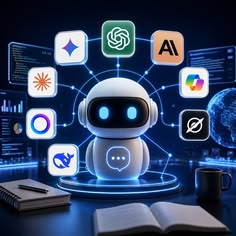
- Threat Detection – Identify unusual patterns across systems and networks
- Fraud Detection – Analyze suspicious transactions and account behavior
- Phishing Detection – Help identify potentially malicious messages and communication
- API Security – Monitor unusual requests and potential abuse
However, AI creates cybersecurity challenges as well.
The same technology that helps defenders can also be used by attackers.
Generative AI can potentially make phishing messages more convincing, accelerate malicious research, and help attackers create more personalized social-engineering campaigns.
This creates an environment where both cybersecurity teams and attackers can benefit from increasingly capable technology.
Another important challenge is securing AI applications themselves.
Businesses are rapidly introducing AI assistants, RAG systems, AI agents, and automated workflows into their applications.
These systems can potentially interact with sensitive company information and external tools.
Organizations therefore need to carefully control what information an AI system can access and which actions it is allowed to perform.
An AI agent connected to a CRM, for example, should not automatically have unrestricted access to every customer record.
Permissions should follow the same security principles applied to employees and traditional applications.
Sensitive actions may also require human approval before execution.
Businesses should additionally monitor AI interactions, maintain appropriate logs, protect credentials, secure APIs, and ensure confidential information is not unnecessarily exposed to models or third-party systems.
At Tech Sonet, we develop custom software, web and mobile applications, AI-powered solutions, APIs, CRM platforms, enterprise systems, cloud applications, and intelligent automation solutions with security and scalability in mind.
As AI becomes increasingly integrated into business applications, software development and cybersecurity will become even more closely connected.
Organizations will need to think beyond:
“How can we use AI?”
They will also need to ask:
“How can we use AI securely?”
The businesses that succeed with AI will not simply be those adopting the newest models and automation technologies.
They will be organizations that combine innovation with security, governance, monitoring, and responsible implementation.
AI has the potential to become a powerful cybersecurity assistant—but technology alone cannot create secure systems.
The strongest digital defense will continue to combine intelligent technology, secure software engineering, strong processes, and human expertise